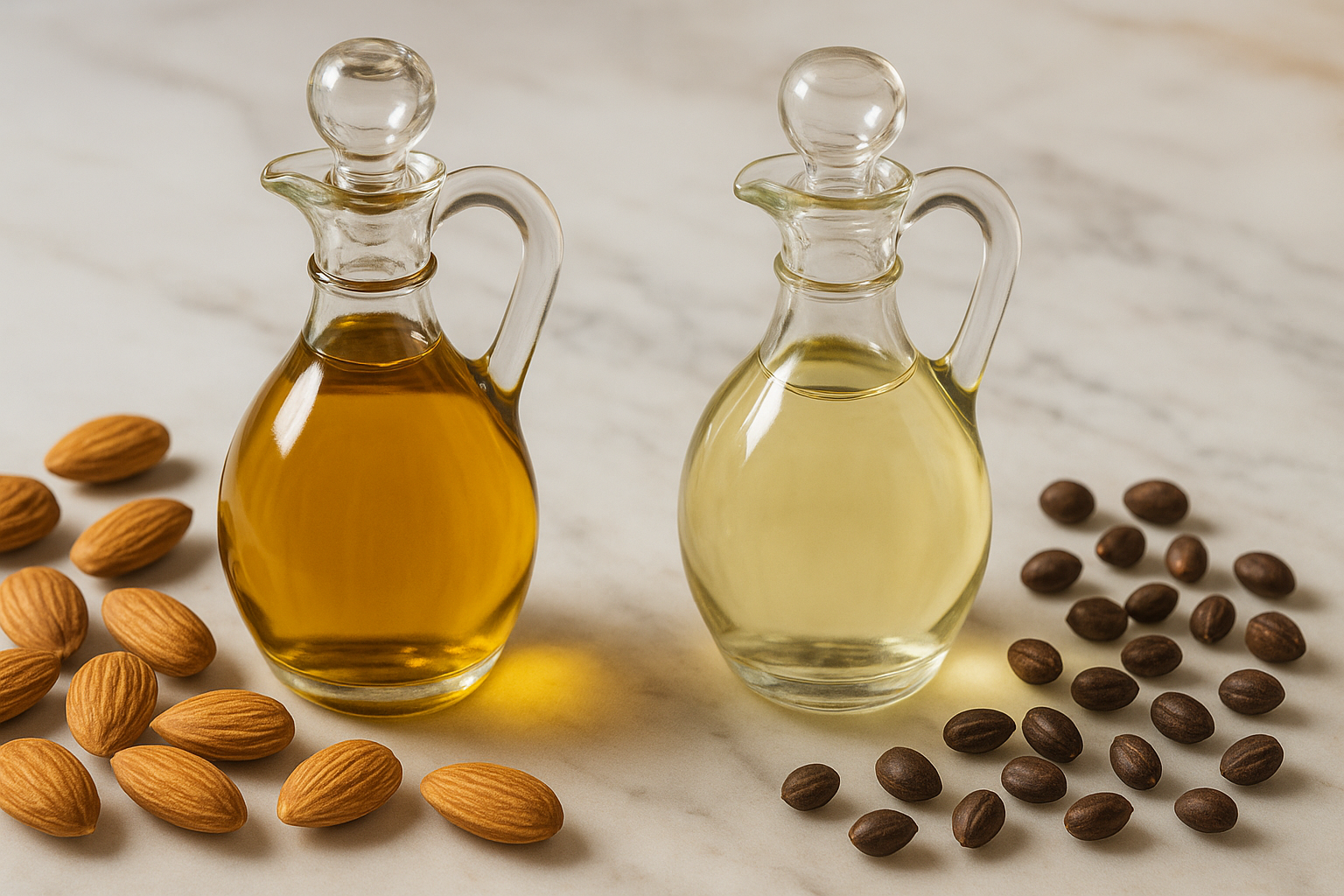
Sweet Almond vs Jojoba: Why I Blend Both Into Our Massage Oil
I'm May, and I grew up in Thailand watching my grandmothers mix oils by hand. Almost every week someone asks me the same question: sweet almond or jojoba — which one is better? My answer disappoints people, because I don't think one wins. They do different jobs on the skin, and our oil uses both for that exact reason. Here's how I'd actually compare them.
Sweet almond oil
Sweet almond is the soft one. It has a light, slightly buttery feel, and it sinks in quickly, so your hands stop sliding after a few minutes and the skin is left smooth rather than slick. I reach for it when I want a finish that doesn't linger on the surface. It carries vitamin E, and on dry or sensitive skin it tends to behave — in years of blending I've rarely seen it cause a reaction. It also takes essential oils well, which matters when you're building a scent on top of it.
The trade-off: because it absorbs fast, it doesn't give you a long working glide on its own. For a quick application it's lovely. For a slow, full-body massage you'll find yourself reaching for the bottle again.
Jojoba oil
Jojoba is technically a liquid wax, not an oil, and that's the whole point. Its structure is close to the sebum your own skin makes, so it sits in that comfortable middle ground — it moisturizes without ever feeling heavy, and it works on oily and combination skin as happily as on dry skin. For massage, jojoba gives you slip. Long, even strokes stay smooth because it doesn't drink in as fast as almond does.
The other quiet advantage is shelf life. Jojoba is unusually stable and resists going off, which means a blend built around it stays fresh longer in your bathroom. The honest downside is that, used alone, that same slowness can leave a faint film some people don't love.
Side by side
- Finish: almond absorbs fast and leaves skin soft; jojoba stays on the surface longer for glide.
- Skin types: almond suits sensitive and dry skin; jojoba suits everything, oily skin included.
- Best use: almond for a quick application; jojoba for a long, unhurried massage.
- Scent: both are close to odourless, so neither fights the lavender and sweet orange we add on top.
- Keeping: jojoba is the more stable of the two and extends the life of a blend.
Why we use both
Here's my real opinion after years at the blending table: pick one and you give something up. Almond alone runs out of glide before a proper massage is over. Jojoba alone can feel a touch slow on the skin. Put them together and they cover each other's weak spots — jojoba carries the long, even slip while almond softens the finish so you're not left feeling coated. Jojoba's stability also helps the whole bottle keep.
That pairing is the base of our oil. On top of it I add argan and avocado for extra cushion, aloe vera for skin that's easily irritated, and a little vitamin E. The scent is lavender and sweet orange — real essential oils, never synthetic fragrance. It's vegan and cruelty-free, blended in small batches the way I was taught, and registered with the Thai FDA (12-1-6700042374). One 300ml bottle is $19.99.
The takeaway most comparisons skip
If you're shopping for a single carrier oil to keep at home, here's the non-obvious part: choose by how long your hands are on the skin, not by skin type. Quick moisturizing after a shower — almond. A slow massage where you want twenty minutes of glide — jojoba. And if you'd rather not decide every time, that's the gap a good blend fills. It's why I stopped choosing years ago.